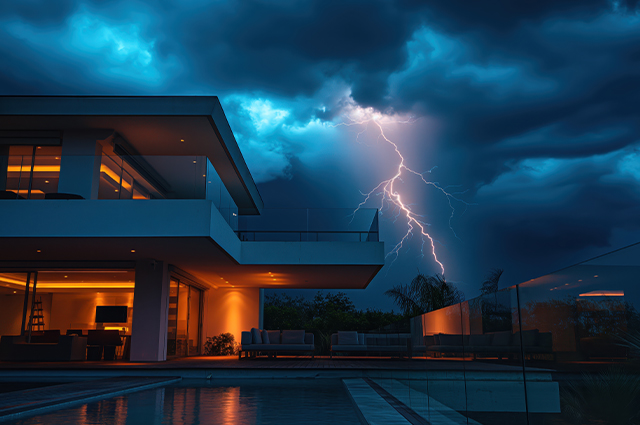
Storm Kristin entered the collective memory for a simple reason: it exposed, in a brutal way, how dependent modern life is on electricity. It only took the grid to fail for everything to become more fragile, from heating to the fridge, from water in homes with a pump to communications, including payments, gates, and the basics of everyday life. In January 2026, many people in Portugal realised this at the same time, and that simultaneity is precisely what makes these episodes so difficult to manage.
Kristin brought strong winds, intense rain, and a succession of incidents that, in practice, mean faults at several points in the distribution network at the same time. In situations like these, restoring supply rarely happens like a click. It requires travel, safety assessment, component replacement, clearing access routes, and testing, all with teams on the ground and with weather conditions that do not always help. The idea that “the grid should withstand everything” sounds good in a comments section, but it loses force when you look at the physical reality: fallen trees and structures, damaged cables, compromised poles, and an entire country needing the same thing at the same time.
One detail that Kristin also helped clarify is that power failures almost never come alone. Communications can become unstable and that multiplies stress, because information arrives late, calls fail, phone batteries start to dictate the situation, and the sense of control disappears. A home without electricity, without a stable mobile network, and without a simple plan turns a technical problem into an emotional problem. That is exactly the goal of this article: to remove emotion from the centre and put a plan in its place.
What you learn from a storm like this in 2026 is valuable for families and businesses. The right question stops being “can this happen again” and becomes “what do I do so that my home keeps working, at least in the essentials, when it happens”.
What Kristin revealed about power cuts and why the impact was so great
A storm with the intensity of Kristin works like a stress test for the electric grid and for household preparedness. On the grid side, faults appear in a chain and in many places at the same time, especially in areas where wind and falling trees hit harder. On the family side, the impact becomes huge because most routines depend on constant electricity, including equipment that used to be “mechanical” and today no longer is. Gates, pumps, heating, hot water, even security systems and garage access.
The scale of the power failures during Kristin shows this cascade effect well. There was a very high peak of customers without supply on the morning of 28 January and, even by the end of the day, hundreds of thousands of people were still without electricity. At the same time, the teams on the ground were reinforced in a significant way. These numbers matter for a practical reason: when a power failure reaches many people at the same time, the average restoration time tends to increase for part of the population, because priority goes to restoring the highest possible number of customers, stabilising infrastructure, and resolving critical faults before reaching the more “isolated” incidents.
This point is often misunderstood and gives rise to easy accusations. The problem is rarely a lack of effort. The problem is volume and simultaneity, added to difficult access and technical work that has to be carried out safely. An electric grid is not repaired by telepathy. It is repaired with hands, vehicles, equipment, time, and validations, and that has physical limits.
Kristin also brought a clear picture of residential vulnerability. Many homes still lack a basic plan for a blackout situation, even if short. And a basic plan does not mean buying expensive things. It means defining priorities, having minimal means of communication, understanding what is needed to maintain safety and reasonable comfort, and knowing how to manage energy when it becomes a scarce resource.
There is a simple lesson here: a resilient home is not a home that pretends everything is normal. A resilient home is a home that keeps the essentials, safely, for the necessary time.
What really works in a power outage and how to avoid the shock of expectations
The conversation about solar energy during blackouts is full of misconceptions, and those misconceptions feed that stigma on social media. Many people believe that solar panels guarantee electricity when the grid goes down. That belief appears because it seems logical. The sun is there, the panels are producing, therefore the house should have power. The technical reality is more demanding.
In a grid connected self consumption system, there are safety protections that prevent “normal” operation when the grid fails, precisely to avoid dangerous situations. Practical result: in many systems, when there is a blackout, the house can be left without power despite having panels. The difference between frustration and resilience lies in the system architecture.
The architecture that responds to power failures always has a common principle: the ability to supply the house in emergency mode, in a controlled way, with a defined set of essential loads. That usually means an inverter with backup capability, a battery for storage, and an essential loads panel that separates what is critical from what is dispensable. In a blackout, that system starts powering only what was planned to be powered, instead of trying to carry the whole house as if it were a normal day.
This detail changes everything because it turns a “total blackout” into a “manageable blackout”. Basic lighting, the fridge, communications, some strategic sockets and, in certain cases, specific equipment, can continue to operate. The focus here is not luxury. The focus is minimum continuity, safety, and the ability to keep the house operational.
The battery enters this story with a very clear role. Storage is used to use energy when it is needed, including at the end of the day, during the night, and in periods of low solar production. The battery also serves to respond to consumption peaks that, in an emergency context, have to be managed carefully. A well sized battery does not turn a house into a fully autonomous island forever. It turns the house into a more prepared house, with less immediate dependence on the grid and with the ability to keep the essentials running during outages.
Here it is worth keeping your feet on the ground and speaking like adults. Winter in Portugal brings days with lower solar production. A strong weather event can bring heavy cloud and low production for part of the day. A realistic resilience strategy is not built on “total autonomy”. It is built on “essentials guaranteed” and “smart consumption management”.
And there is more. Resilience does not start with a battery. It starts with the ability to maintain communication and information. In many blackouts, a simple uninterruptible power supply for the router, combined with power banks and proper lighting, already reduces anxiety a lot and gives control back. From there, the next level comes in, which is the solar system with battery and essential loads circuit, for those who want an integrated and long lasting solution.
Another rarely discussed point deserves attention in 2026: when electricity returns, it can bring spikes and disturbances. Well thought out electrical protection in the installation helps reduce the risk of damage to sensitive equipment. A prepared home thinks about both the “during” and the “after”.
What families can learn from Kristin and how to turn that into a practical plan for 2026
The useful learnings from Kristin fit into one central idea: preparation is choosing before the problem appears. When the power failure is already happening, the decision becomes emotional, and emotional decisions tend to be expensive and incoherent.
The first step is to define what is essential for you. Each home has its own reality. A family with small children will prioritise thermal comfort and routine. A home with elderly people or medical equipment will prioritise continuity of power at specific points. A detached house with a water pump will prioritise supply. A home with remote work will prioritise communications and minimum stability.
The second step is to define the coverage time that makes sense. A power failure can last minutes, hours, or, in more complex cases, longer in some areas. Kristin showed that the country can enter a phase of gradual restoration. Your preparation should think in hours and in days, with realism and without drama.
The third step is to choose the level of solution that fits your case. Some families are very well served by a simple contingency plan, designed for 24 to 72 hours, with safe lighting, energy for communications and food management. Other families benefit from an integrated energy solution, with self consumption, a solar battery and an essential loads circuit, to keep the essentials running and reduce dependence on the grid in critical moments.
The fourth step is to size with numbers, not with “guesses”. Here comes the part that separates a good decision from a story to tell on social media. A battery that is too large for essential consumption becomes idle money. A battery that is too small for what you expect to power becomes frustration. Serious sizing starts with real consumption and with simulation of the essentials in an outage scenario. The question that drives the decision is objective: how much energy do you need to keep the essentials for X hours, and what is the best way to guarantee that safely.
The fifth step is to integrate habits. Resilience is also management. In emergency mode, the house needs clear priorities. Oven and hob at the same time can be a luxury. Heating can require strategy. Washing and drying machines can wait. The difference between coping well and coping badly is often in the simple discipline of consumption.
Storm Kristin did not prove that everyone needs a solar battery. It proved something stronger: many homes live without any strategy for power failures, and that makes any weather event heavier than it needs to be. A well designed strategy gives control back, reduces stress, and turns a blackout into a manageable inconvenience.
Conclusion: the true lesson of Storm Kristin for 2026
Storm Kristin left a clear message for 2026: electricity failures happen, especially when the weather tightens, and a prepared home goes through those moments with much more calm. The gain here goes beyond savings. The gain is called continuity.
A prepared family knows what is essential, knows how long it wants to cover, and chooses solutions that are coherent with its reality. In some cases, that means simple measures that guarantee communication and safety. In other cases, it means solar energy with a battery and a backup system designed to keep essential loads running during a blackout. The common point is always the same: planning, serious sizing, and expectations aligned with the real world.
Kristin turned a technical topic into a national conversation. In 2026, that conversation can evolve into better decisions, less noise, and more energy resilience at home.